Quiet sensors, loud signal — what I'm building, in public
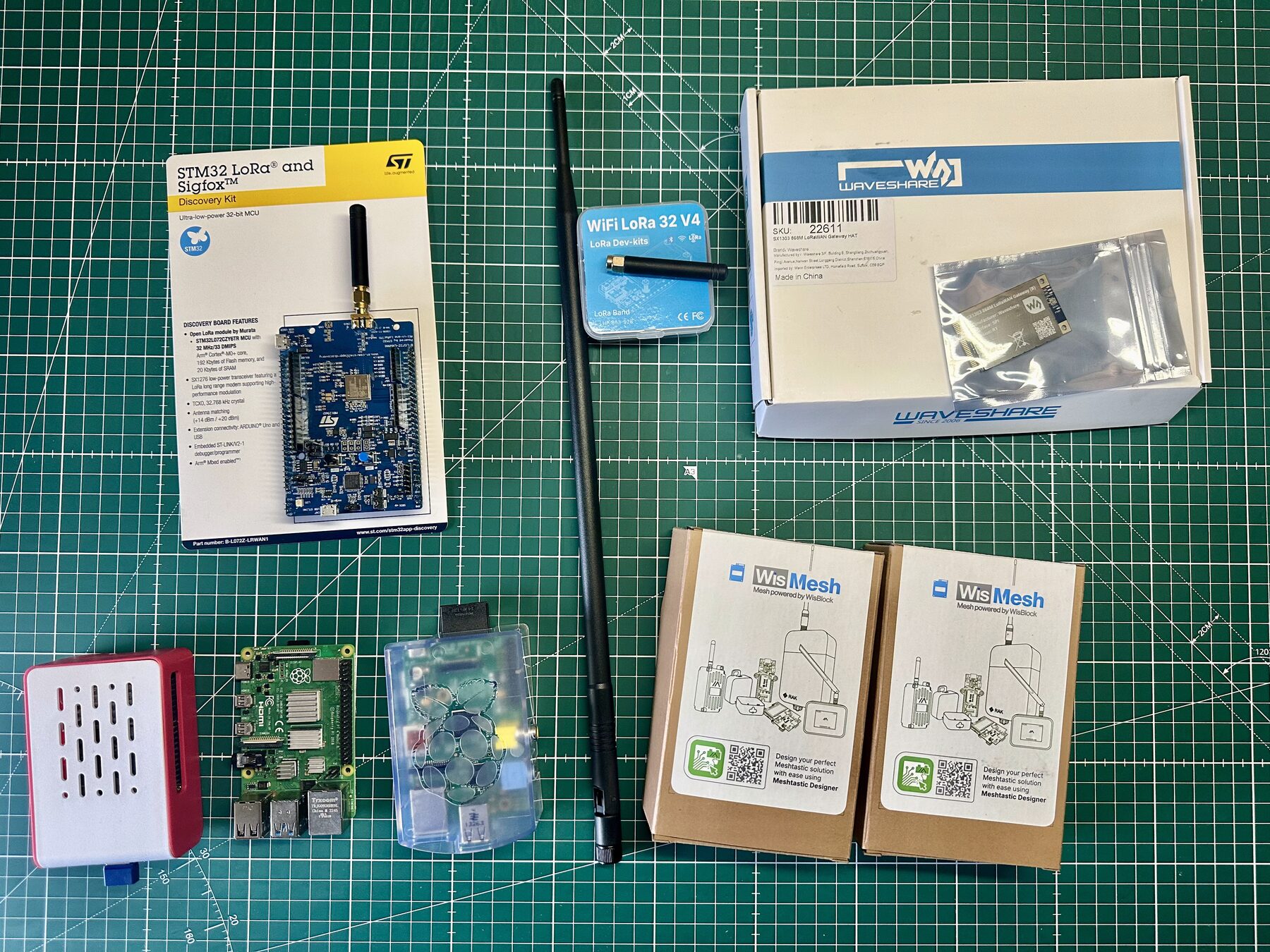
On the bench in the workshop: an STM32 Discovery kit, a Waveshare gateway HAT, three Raspberry Pis, a diymore LoRa V4 board, and — fresh in the post — two Meshtastic nodes still in their boxes. The kickoff for a six-month learning-in-public series on LoRaWAN and Meshtastic.
On the bench in the workshop: the kit I'm going to use for the next six months.
In no particular order: an STM32 Discovery kit with a Murata radio module on it, a Waveshare gateway HAT for a Raspberry Pi, three Raspberry Pis (a 3, a 4, and a 5), an ESP32-based diymore "LoRa V4" board for the second LoRa node, a small handful of antennas of dubious provenance, and — as of this morning's mail — two Meshtastic nodes still in their shipping boxes. Outside the window, a low English sky, the kind that promises rain by tea-time. Inside, the smell of soldering flux and instant coffee.
This site is going to follow that bench, in public, for the next six months.
Why this site exists
Rural Scotland has a connectivity problem that doesn't show up on any operator's coverage map, because the operators don't sell what's needed. A sheep collar doesn't want 5G. A water-trough sensor on a hill farm doesn't want LTE-M. They want a few bytes a day, ten years on a coin cell, and a signal that crawls through wet bracken without sulking. The class of radio that does this is called LPWAN — Low Power Wide Area Network — and the two technologies in it that I care about are LoRaWAN and Meshtastic.
I am not an expert. I am a software engineer with fifteen years of building things in Java and a more recent habit of dragging Raspberry Pis up hills. The radio side is new to me. I have read a lot of marketing PDFs and watched a lot of conference talks, and I am at the point where I either commit to building something real or admit that I have spent, again, lots of money on a pile of plastic and silicon that will sit on a shelf gathering dust.
So: real, in public.
The contract
Every Sunday for the next six months, or likely more, there will be a new post here. Each post will be the result of one weekend of actually doing the thing — not reading about it, not summarising someone else's tutorial, but flashing firmware, mounting antennas, writing down RSSI numbers in pencil and typing them up in the evening.
The arc looks roughly like this. The first three months are LoRaWAN: starting with raw point-to-point LoRa over 868 MHz on the Discovery kit, then onto The Things Network, then standing up my own gateway with the Waveshare HAT, then self-hosting the whole network server with ChirpStack on a Pi 5. The next two months are turning that working stack into something useful — a real sensor in the garden, dashboards in Grafana, battery-life numbers measured rather than guessed. The last month is Meshtastic, on the nodes that landed on the doormat this morning and are sitting on the table, still sealed, while I write this.
Twenty-one weeks of LoRaWAN, six weeks of Meshtastic, one retrospective.
I'll publish the full plan in the companion repo as a living document, with strikethroughs intact, because pretending the plan was always right is the most boring possible content.
What's on the bench right now
For anyone who wants to follow along with the same hardware:
- STM32 B-L072Z-LRWAN1 Discovery kit — the Murata module on this is a SX1276 LoRa radio bonded to an STM32L072 microcontroller. About £40 from the usual places. EU868 region. ST-Link onboard, so a single USB cable handles flashing and serial.
- Waveshare SX1303 868M LoRaWAN Gateway HAT — a proper 8-channel concentrator, not one of the £20 single-channel listeners that pretend to be gateways and aren't. About £100. Plugs onto a Pi's GPIO.
- Raspberry Pi 3, 4, and 5 — the Pi 5 will end up running ChirpStack later in the series. The Pi 4 is the gateway host for now. The Pi 3 is the spare for experiments. I'm not sure what the price for these boards is these days; they were sitting doing nothing for at least a year.
- A diymore "LoRa V4" board — ESP32-S3 with a SX1262 radio and an onboard GPS, about £35 from Amazon. The Discovery kit only ships with one board, and you can't do point-to-point with one of anything, so this is the second node for the early experiments.
- Two WisMesh Meshtastic nodes — arrived this morning, still in their boxes; the cost was about £90 for the pair. They sit out of the picture for now; the Meshtastic phase isn't until late in the series. Mentioned here only so the bench inventory matches the photo above.
Total spend so far is just under £300, which is a useful number to have written down somewhere honest. There are people doing this with much more and people doing this with much less (£15 Heltec board and a Pi Zero will get you a long way). The £300 sits in a comfortable middle for quite a lot of tech.
Why "in public"
A handful of reasons, in order of how much they matter to me.
The selfish one first: if I commit publicly to a weekly post, I will actually do the work. Without the deadline, the bench in the workshop will look exactly like that photo in February — same boards, same dust, same shrink-wrap on the Meshtastic boxes.
The honest one: I am going to make mistakes that are interesting. I will mount the antenna upside down, or burn out a regulator, or spend three hours debugging a packet that turns out to be a duty-cycle violation by my own kit. These are the posts I'd most like to read from someone else, and the ones that vendor blogs cannot write because vendors have brand to protect. I do not have a brand to protect. I have a bench, a soldering iron, and an inquisitive mind.
The useful one: I genuinely think the rural-Scotland LPWAN market is undercooked. The kind of hill farm I have in mind could justify a £150 sensor that lasted three years and pinged when the gate was open. Almost none of them have one. The reason is not the radio; the reason is the missing middle layer between "Semtech datasheet" and "deployment that survives a wet October". I want to write that middle layer down.
What's coming next week
Next Sunday I'll publish the second piece of Phase 0: a comparison of LoRa, LoRaWAN, Sigfox, NB-IoT, and Meshtastic. Not a fight — most "X vs Y" posts pick a winner and rig the rules. A family tree. By the end of it you should be able to use those five words correctly in a sentence and know which one to reach for when.
Then in week three things go on the bench in earnest. The Discovery kit unboxing and first boot. Maybe first packet. Maybe first dead-end driver. Depends how lucky I'm feeling.
If you have hardware on a similar bench, or you spot something I'm getting wrong, the inbox is open. The plan above is going to be wrong in interesting ways, and the corrections are going to make this series better.
Until next Sunday, the kit stays on the bench.